
What 790 home sales tell us about the most common question sellers ask.
Every fall, sellers ask us a version of the same question. We’re thinking about moving, but should we wait until spring?
The conventional answer is yes. Spring is when houses sell. Everyone knows it.
We wanted to know whether that’s still true, and more importantly, what it’s actually worth. So instead of relying on instinct, we analyzed every single-family home sale over a recent four-year period in one desirable Greater Boston suburb near Cambridge. All 790 of them.
The answer surprised us, and it changed how we advise sellers.
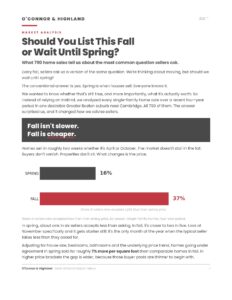
Fall isn’t slower. Fall is cheaper.
This was the finding we didn’t expect.
Homes sell in roughly two weeks whether it’s April or October. The market doesn’t stall in the fall. Buyers don’t vanish. Properties don’t sit.
What changes is the price.
In spring, about one in six sellers accepts less than asking. In fall, it’s closer to two in five. Look at November specifically and it gets starker still: it’s the only month of the year when the typical seller takes less than they asked for.
Adjusting for house size, bedrooms, bathrooms, and the underlying price trend, homes going under agreement in spring sold for roughly 7% more per square foot than comparable homes in fall. In higher price brackets the gap is wider, because those buyer pools are thinner to begin with.
Why the gap exists, and it isn’t weather
The explanation matters, because it tells you what to do about it.
In a competitive sale, the price isn’t set by the most motivated buyer. It’s set by the second most motivated one, because that’s who the winner has to outbid.
Spring doesn’t just bring more buyers. It brings them at the same time. Four buyers walk through on the same Sunday, and one of them pays a premium to win. In November, one buyer walks through, nobody is bidding against him, and he pays exactly asking price. Not a dollar more.
It also isn’t arbitrary. In towns where families buy for the schools, the premium clusters tightly in a narrow window, because buyers are working backward from a move-in date before the school year starts. They have a deadline. Sellers don’t. When one side of a negotiation has a deadline and the other doesn’t, pricing power shifts.
Download the Timing Case Study
What waiting actually costs
Here’s where most advice stops short. Everyone tells you spring is better. Almost nobody does the other half of the math.
Take a $1,000,000 home as an illustration. Waiting roughly four months to reach the spring market:
|
Expected gain from better timing |
about $60,000 |
|
Property taxes, insurance, utilities |
about $5,300 |
|
Mortgage interest over four months |
about $10,400 |
|
Opportunity cost on your equity |
about $8,000 |
|
Net expected benefit |
about $36,000 |
One detail matters and is almost always gotten wrong. Mortgage principal is not a cost. It’s savings. It converts to equity and comes back to you at closing. Counting your full monthly payment as the cost of waiting can overstate it by a third and push you into a decision the numbers don’t support.
Run properly, the question becomes concrete. For that $1,000,000 home, the market would have to fall about 3.5% before waiting becomes the wrong call.
When listing now is the better answer
Waiting isn’t right for everyone, and we’ve advised plenty of sellers to go this fall. List now if:
-
You can’t comfortably carry two properties. If you’ve already bought, the certainty of getting out often beats an expected gain on paper.
-
Your home needs work that can’t be done in time. A rushed spring listing at the wrong price is worse than a well-prepared fall one. Condition beats calendar.
-
You need the proceeds before year end, whether for tax planning, a purchase, or anything else.
-
Your home is unusual, with a narrow buyer pool. Thin markets punish distinctive properties less predictably in either direction.
-
Waiting would genuinely weigh on you. This is a real reason, not a soft one. Financial models don’t price peace of mind, and carrying a second property through a New England winter is not nothing.
If you do wait, don’t wait passively
This is the part that separates sellers who capture the spring premium from sellers who merely show up for it.
The preparation that makes spring work happens in the fall.
Shoot your exterior photos now, before the leaves turn. This is the single most time-sensitive thing on the list, and almost everyone misses it. Photos taken in January look like January: bare branches, gray sky, dead lawn. Green foliage reads as season-neutral to a buyer browsing in March. Peak fall color is beautiful and instantly dates the picture. The window is short, and once it closes the next comparable one is late April, well after you’d want to be live.
Do the work over the winter. Paint, flooring, deferred maintenance. If you’ve already moved, you have an advantage most sellers never get: an empty house and no pressure.
Price against live data, not stale data. Set your number a few weeks before launch using current comparables, not last fall’s.
Go live early in the window. More buyers arrive as spring progresses, but so do more competing sellers, and the seller side catches up fast. Being early in the spring market matters more than being in the middle of it.
By the time a well-run listing goes live, it should have been in preparation for months.
The takeaway
“Wait until spring” isn’t wrong. But it’s incomplete, and treated as a rule of thumb it costs sellers money in both directions. Some wait when they should have listed. Others list into the thinnest market of the year without knowing that’s what they’re doing.
The right answer depends on your equity, your carrying costs, your property, and your tolerance for holding an asset you’d rather be out of. Those are knowable. They just have to be calculated rather than assumed.
Where we work
O’Connor & Highland is a seven-agent team serving Arlington, Belmont, Watertown, Somerville, Cambridge, Medford, Lexington, the South End, Jamaica Plain and the surrounding Greater Boston communities. Seasonality is not identical everywhere. The towns closest to Cambridge, where buyer demand is driven heavily by school calendars and commuting patterns, tend to show the sharpest spring concentration, while markets with a different buyer mix behave differently.
That’s the reason we run this analysis town by town rather than applying one rule across the region. What holds in Arlington doesn’t automatically hold in Jamaica Plain, and the difference is worth real money to a seller.
Curious what the numbers look like for your home? We’ll run the same analysis on your specific address and price point, including what waiting would actually cost you and what it would likely be worth. No obligation, and no pressure to list in any particular season.